Archival Research in Boston: A Student’s Perspective

Today, we are excited to feature a guest post by Hope College student Hope Hancock who conducted research at the Massachusetts Historical Society in May 2014. Be sure to check out Hope’s Voices of the Exhibition project to see what she has done with her research!
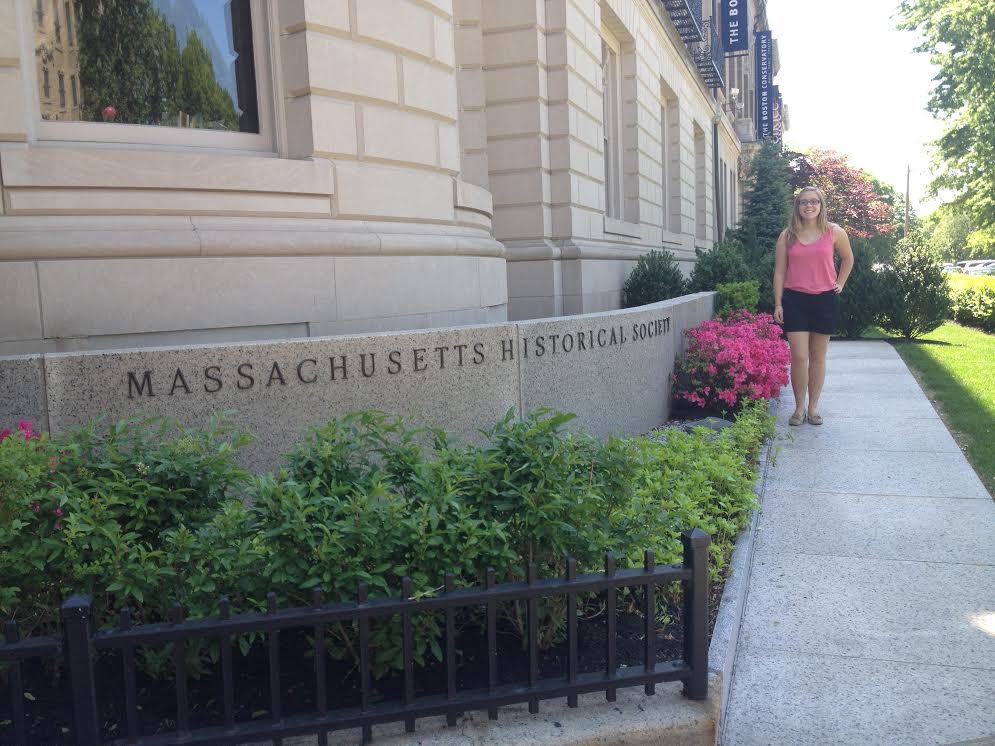
Hope Hancock outside the Massachusetts Historical Society, May 2014. 

Hope Hancock outside the Massachusetts Historical Society, May 2014.

As I walked into the Massachusetts Historical Society, I was 99% sure I was not where I was supposed to be. Certainly this beautiful building complete with chandeliers, marble floors, and some of the oldest documents in United States history wasn’t for an undergraduate student, right? I’m a small-town girl at a small college: Boston wasn’t ever in the game plan, let alone doing research at one of its top archival institutions. But there I was, nervously waiting for my professor, Natalie Dykstra, in the front lobby, about to begin my summer research project “Voices of the Exhibition.”

Last summer I received a generous grant from the Hope College Mellon Scholars program. My research focused on the Centennial Exhibition of 1876, and my goal was to find first-hand accounts of people who visited the fair and to create podcasts, based on these sources,that told of their experiences. I remember sitting in the MHS, doing research among others busily working on their dissertations or authors working on what would surely become the next New York Times bestseller. Perhaps some of the people were undergraduate students like myself, embracing the opportunity to absorb some of the richest documents in United States history.

I’d be neglecting a huge portion of my trip, if I didn’t mention all of the other learning opportunities Boston provided. After I had put in my hours at the archive for the day, I would wander around Boston for the evening. Boston is a very walkable city. The public transportation is easy to use, and the MBTA has a couple very helpful apps. And the city isn’t very big. If you can find your way to the Boston Common, you can probably get anywhere else. Boston is also divided nicely into different neighborhoods. Want to see the “hipster” part of town? Go to the Berklee College of Music campus (near the MHS). Would you like to experience Italy? Definitely visit the North End. How about the harbor and some delicious seafood? Go to Faneuil Hall and walk around the shore. I haven’t even mentioned Freedom Trail and the wonderful historic buildings you can visit. I left a piece of myself in Boston and I’m itching for the opportunity to go back. I have folders full of digitized materials from the archives and many ideas of potential research projects for the future. And by the time I left the MHS, I didn’t feel quite so inadequate. Maybe I wasn’t working on a dissertation or a book, but I was sitting in a quiet room full of people with the same purpose: to bring history to life.

If you’d like to hear more (or read more about my trip), visit hopehancock94.wordpress.com and click on “Voices of the Exhibition.” Listen to my introductory podcast below! Any questions? Find me on Twitter @HopeHancock94.
New Proposal Submission Date!

Are you planning to submit a proposal for the Boston Summer Seminar 2015? Please note that the due date has changed! After review by the selection committee, the dates have been moved back to allow more time for proposal preparation.

The due date for group proposals is Friday, January 30, 2015.

Details for submitting a proposal can be found on our To Apply page.

Remember that we are also available to address your questions and concerns as you prepare your proposal. Please contact

Natalie Dykstra
Department of English, Hope College
ndykstra@hope.edu

The committee is also happy to review any part or all of a draft proposal packet for comment and revision prior to the submission date. Feedback will be provided on a rolling basis, and the committee will accept drafts for review up through Friday, January 16th

Proposals Due One Month From Today!

Are you planning to submit a proposal for the Boston Summer Seminar 2015? Remember that the due date for group proposals is Friday, January 16, 2015.

Details for submitting a proposal can be found on our To Apply page.

Remember that we are also available to address your questions and concerns as you prepare your proposal. Please contact

Natalie Dykstra
Department of English, Hope College
ndykstra@hope.edu

The committee is also happy to review any part or all of a draft proposal packet for comment and revision prior to the submission date. Feedback will be provided on a rolling basis, and the committee will accept drafts for review up through Monday, January 5th. Drafts submitted on the 5th will be returned with feedback no later than Friday, January 9th.

2015 Partner Institutions: Schlesinger Library

During November and December, the Boston Summer Seminar (BSS) blog is profiling the four sites at which BSS participants are invited to conduct research during their residency in Boston. We hope these profiles will encourage you in your exploration of each institution’s holdings, and prompt helpful conversations with the Seminar Director and Seminar Archivists in preparing your proposal. This week we take a peek at the Archives & Special Collections at the Schlesinger Library.

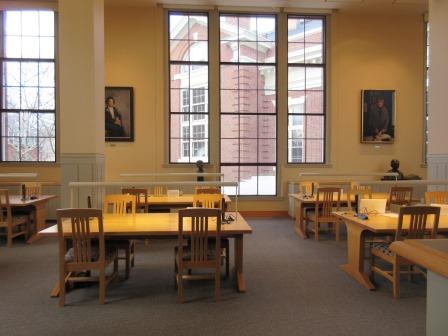
Reading Room, Schlesinger Library

Reading Room, Schlesinger Library

On August 26, 1943, Radcliffe College received from alumna Maud Wood Park (1898) her collection of books, papers, and memorabilia on the suffrage movement, in which she had been a leader. Park’s  “Woman’s Rights Collection” became the nucleus of a research library called the Women’s Archives.  Originally imagined to document the politics of women’s rights and reform, the collection was then expanded by Radcliffe College to encompass many other activities and ambitions of women. In 1965, it was renamed to honor Harvard University historian Arthur M. Schlesinger and his wife Elizabeth Bancroft Schlesinger, who had supported the effort from its beginning.

In the subsequent surge of a new women’s movement, as feminist activists highlighted the importance of women’s history and created their own documents and publications, the collections multiplied very rapidly and have continued to do so ever since. Now part of Harvard University’s Radcliffe Institute for Advanced Study, the Schlesinger Library prides itself on being an outstanding repository for materials documenting women of the United States at home and abroad. With the finest collection of resources for research on the history of women in America, the library’s holdings are strong in: women’s rights and feminism; health and sexuality; work and family life; education and the professions; and culinary history and etiquette. Library holdings date from the founding of the United States to the present and include more than 3,200 manuscript collections (including personal papers, family collections and organizational records), 100,000 volumes of books and periodicals, and films, photos, and audiovisual material. The Library offers grants and has a regular program of in-house exhibits.

Materials from the Schlesinger collection

Materials from the Schlesinger collection

The Schlesinger Library is open to the public and welcomes all visitors. Several online tools are openly available for discovering materials of research interest. All Schlesinger holdings are cataloged in HOLLIS+, the Harvard Library discovery tool.  Schlesinger finding aids/inventories to manuscript collections are available in Harvard’s OASIS system. Harvard’s image catalog,  VIA contains over 40,000 photographs from the Library’s collections.  We invite researchers to explore these tools and to learn more about our collections from our subject guides.  While not an exhaustive list of subjects, the guides present a sampling of the variety of topics and materials available for research.  Please just Ask a Schlesinger Librarian for assistance. All researchers are encouraged to review our visitor’s guide in advance of a research visit. 

The library maintains a dynamic Facebook timeline as well as a recently launched Reading Room Twitter account. We encourage researchers to share their research finds on these social media channels. The Library also has a  Flickr stream  which is continually growing, offering a fun way to browse images and see more of the Library’s holdings.

~ Sarah Hutcheon, Reference Librarian, Schlesinger Library

2015 Partner Institutions: Northeastern University Archives and Special Collections

During November and December, the Boston Summer Seminar (BSS) blog is profiling the four sites at which BSS participants are invited to conduct research during their residency in Boston. We hope these profiles will encourage you in your exploration of each institution’s holdings, and prompt helpful conversations with the Seminar Director and Seminar Archivists in preparing your proposal. This week we take a peek at the Archives & Special Collections at Northeastern University.

Snell Library, Northeastern University (Boston, Mass.)

Snell Library, Northeastern University (Boston, Mass.)

The Archives and Special Collections at the Northeastern University Libraries houses and carefully curates a diverse and growing collection of historical records relating to Boston’s fight for social justice.  Their charge is to preserve the history of Boston’s social movements, including civil and political rights, immigrant rights, homelessness, and urban and environmental justice.  The Archives focus on the history of Boston’s African American, Chinese, LGBTQ, Latina/o and other communities, as well as Boston’s public infrastructure, neighborhoods, and natural environments. The primary source materials we collect and make available are used by community members, students, faculty, scholars, journalists, and others from across the world as the evidence on which stories, histories, and biographies are built.  The use of these records will lead to a deeper understanding of the past. An understanding of the past can help our society by inspiring the next generation of leaders to continue the fight for equal economic, political and social rights and opportunities. Continue reading

2015 Partner Institutions: Massachusetts Historical Society

Over the next six weeks, the Boston Summer Seminar (BSS) blog will be profiling the four sites at which BSS participants are invited to conduct research during their residency in Boston. We hope these profiles will encourage you in your exploration of each institution’s holdings, and prompt helpful conversations with the Seminar Director and Seminar Archivists in preparing your proposal. We begin this week with the 2015 host institution: the Massachusetts Historical Society.

Seminar meetings will be held Tuesdays and Thursdays in the intimate space of the MHS Seminar Room.

Boston Summer Seminar meetings will be held Tuesdays and Thursdays in the intimate space of the MHS Seminar Room. MHS Photo Archives.

Founded in 1791 the Massachusetts Historical Society is an invaluable resource for American history, life, and culture. Its extraordinary collections tell the story of America through millions of rare and unique documents, artifacts, and national treasures, including the personal papers of three presidents—John Adams, John Quincy Adams, and Thomas Jefferson–and their families. Through its research library, online resources, publications, exhibitions, and programs, the MHS makes its holdings accessible to anyone with an interest in the people and events that shaped our country. Spanning four centuries, the Society’s collections—the letters, diaries, and other personal papers of individuals and families, as well as their books, photographs, pamphlets, maps, newspapers, historical artifacts, and works of art—have become essential primary sources for the study and understanding of American history. It is possible to see, from the wide variety of projects which have been awarded fellowship funding in recent years, that the MHS collection supports a broad range of topical and methodological inquiry. Continue reading

Dreaming of the Dead

 Image courtesy of the Massachusetts Historical Society. This photograph by Clover Adams, taken August 8, 1883, was the image that first caught my attention. I’d seen this sort of composition before, in European and American paintings, but I’d not seen figures arranged this way in a nineteenth-century photograph. For more of Clover’s photographs, see the online collection at http://www.masshist.org/features/clover-adams.


Image courtesy of the Massachusetts Historical Society. This photograph by Clover Adams, taken August 8, 1883, was the image that first caught my attention. I’d seen this sort of composition before, in European and American paintings, but I’d not seen figures arranged this way in a nineteenth-century photograph. For more of Clover’s photographs, see the online collection at http://www.masshist.org/features/clover-adams.

On Saturdays as a kid, I’d often go with my dad to our local library in the Chicago suburbs, and while he picked out books for himself and my mom for that week’s evening reading, I’d scoot to my favorite place in the library – an area that held the bound copies of Life magazine. I’d pick a year – 1946 or 1958 or 1963 (a packed year for news) – and settle down on the floor between the metal shelving, safely hidden from view, to work my way through that year’s issues. The large pages were still crisp, as if just published, but they held an aroma – almost unmistakable – of the past. Continue reading

Inaugural Call for Proposals

The GLCA Boston Summer Seminar invites proposals from faculty-student research teams to participate in a brand new opportunity to spend three weeks in June 2015 conducting primary source research in some of America’s premier special collections repositories.The new program, sponsored by the Great Lakes Colleges Association (GLCA) and hosted by the Massachusetts Historical Society (MHS), will bring together three to five faculty members from GLCA colleges, each with a team of two to four undergraduate students, for three weeks of intensive primary source research in Boston archives. The 2015 partner institutions are the MHS; the Schlesinger Library at the Radcliffe Institute for Advanced Study (Harvard University);  the Center for History of Medicine at the Francis A. Countway Library of Medicine (Harvard University); and Northeastern University’s Archives & Special Collections.

Faculty participants will submit research proposals on a broad theme, such as “Gender and the Civil War,” “Nineteenth-century Food Culture,” or “Personal Narratives of WWI.” Teams from a wide range of humanities disciplines are encouraged to apply; all projects centered on primary source research will be considered.  Students will complete research for their own projects within the broadly-conceived theme, while faculty members will have plenty of time to “dive deep” into their archival research. While we expect the students not to serve simply as transcribers or research assistants for the faculty member, the group dynamic and end work product of each research team will be up to the faculty mentor to design.

Each seminar participant will be paired with a librarian or archivist from one of the partner institutions who will provide on-site support and expertise prior to, during, and after the residency period.

The seminar, to be held June 1 – 18, 2015, will center on primary source research, requiring participants to spend fourteen days in the archive. In addition, the program will include Tuesday and Thursday evening group meetings for guest lectures and discussions, as well as a day-one orientation and a closing celebration when participants will present their work.  Students and faculty members will also have scheduled individual meetings with archivists and with the coordinator of the seminar.

To apply, please visit the To Apply page where you can read or download the full call for proposals.

If you have questions, please email either the Seminar Director Natalie Dykstra (ndykstra@hope.edu) or one of the two Seminar Archivists: Hanna Clutterbuck-Cook at the Center for the History of Medicine (hanna_clutterbuck@hms.harvard.edu) or Anna Clutterbuck-Cook at the Massachusetts Historical Society (acook@masshist.org).

Coming Soon!

This is — or will be soon! — the home of the Boston Summer Seminar under development through the Great Lakes Colleges Association & the Massachusetts Historical Society.

Please email bostonsummerseminar [at] gmail [dot] com with any questions and bookmark this site for more information coming in the next couple of months!